
Constant Team Changes by Consultants in IT Projects Causes Clients to Lose Confidence; Key Contributor to Project Failure
LONDON, 9 October 2008 -- Team changes, however small, within IT consulting projects can equate to a "loss of confidence" by the customer, according to a recent study by Coleman-Parks Research, sponsored by Fujitsu Services.
Among the companies interviewed in the study, 33 percent of respondents now contemplate changes to contracts that limit or control the number of team changes.
Rob Devlen, head of business consulting at Fujitsu Services, said, "IT consultancies will have to begin showing initiative in this direction and start incorporating team change guarantees into the contracts before they become mandated by customers. Any team changes that need to be made will need to be managed more carefully. Currently, 58 percent of companies interviewed, experience team changes of three or more throughout the duration of the project, with 4 percent of projects experiencing over 10 team changes."
The issues with team changes on an IT project relate to the impact that the changes have on the overall project success, as well as the impact on team dynamics and the overall client relationship. According to Fujitsu and Coleman-Parks, one way to understand this is to look at the way the firm is structured from a business model perspective, and, by association, its project teams.
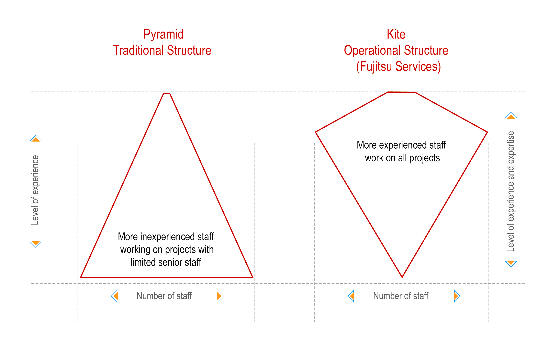
According to Devlen, "A 'pyramid style structure' (see Exhibit), with increasing numbers of resources as you move down and through the grades, can lead to more detrimental team changes. For example a project structure with two senior consultants and four junior consultants would mean that if one senior consultant was moved onto a different project this would lead to greater instability and uncertainty with regard to direction for the junior members."
Devlen continued, "On the other hand if a consultancy has a model that resembles a kite (i.e. the bulk of the consultant base is highly experienced) there tends to be less of an impact on the project team if one of five senior consultants is moved on. There still remains the similar high level contact with the client and the work can be easily shared among the remaining consultants so the client does not see any dip in project output."
Fujitsu suggests the following Five points to assess when a company is looking to engage an IT consultancy:
1. What is the shape of your consultancy's team structure? Pyramid = team changes will have a significant impact; Kite = team changes will have less impact
2. Confirm the level of senior management involvement there will be during the project's duration.
3. What checks does the consultancy use to ensure delivery is being achieved?
4. Is there is a cultural fit between you and the consultancy?
5. Does the consultancy have clear and defined approaches and methods for undertaking the work?
Ian Parkes, director, Coleman Parkes Research, said, "There is some good news in all this, 24 percent of companies interviewed already set the number of team changes in the contract -- but compared to the rest of the industry this is still too small a number and it highlights that there are still many areas that need addressing to ensure a smoothly run IT change project using an IT consultancy company."
MR Perspective
Monadnock Research refers to the business model advocated by Fujitsu as the diamond model. It is employed frequently by operations management consultancies where deep skills and industry expertise are key to project success. If there is significant turnover of project staff in the heart of the diamond, it can be more devastating than a similar level of turnover in the lower levels of the pyramid. Strategy firms typically employ project teams utilizing the pyramid model, and this model is extremely effective for that type of project work.
Regardless of the model employed by the firm, we have found that clients with the most advanced capabilities in working with consulting partners (what we refer to as Value Leaders), closely monitor not only the turnover numbers, but the specific individuals that are assigned to the project from beginning to end.
It depends on the phase and the scope of the project, which model provides the best fit. In early strategy phases of an IT project, a pyramid structure might provide the most appropriate fit. When assessing and reengineering business processes, a diamond (or kite) model is best. And when implementing the final IT solution, a hybrid model is often employed, sometimes incorporating the resources of more than one vendor and internal client teams.
Monadnock Research recommends incorporating key staff provisions into project statements of work, specifically naming key individuals and employing client sign-off procedures for transitioning key staff when changes are required.