
EC Commissioner Barnier Considers Prohibiting Auditors from Offering Consulting
BRUSSELS - The EC Commissioner for Internal Market and Services, Michel Barnier, addressed a conference of the Federation of European Accountants on 30 June, and advocated for a number of auditor regulatory changes that could include a total ban on audit firms providing consulting services and mandated rotation of auditors.
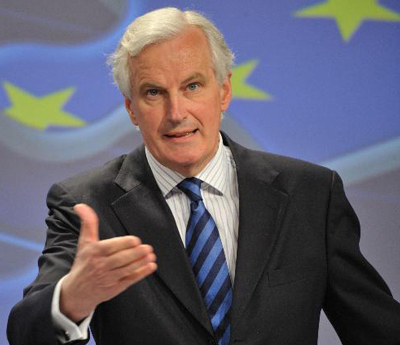
Barnier is the EC official responsible for the Internal Market and Services Directorate General and Office for Harmonization in the Internal Market. Speaking before the federation of European CPA's Barnier intimated that he believes the regulatory environment for auditors in Europe is deeply flawed and in need of significant reform.
Barnier focused specifically on three main issues that he is working to address in regulatory reforms:
- Independence of the audit profession
- Opening of the audit services market
- Creation of a European market for audit services that is more integrated and reinforced by associated regulatory supervision
Audit Quality and Credibility Crisis
Barnier expressed concern for the quality and credibility of the audit as his underlying motivation for reform. He sees limited confidence of company stakeholders that the accounts of corporations accurately represent their true financial condition, and this is largely do stakeholders questioning today's auditor independence. This climate of distrust could harm investments, and is the vicious cycle that Barnier wants to reverse.
Independence Question
Independence of auditors is viewed as an indispensable condition to ensure full confidence in reports and ratios reported. The auditor needs to be above all suspicion, and stakeholder perceptions of auditor independence are crucial. But today, auditors are often too related to the companies they audit.
Barnier said, "When the finance manager of a large European company declares that it awaits from his auditor a certain 'docility,' it harms all the profession. When it is seen that many companies retain the same auditor firm for decades - even more than a century - that harms the profession. As the fact that the selection of the auditor is not done according to regular and transparent invitations to tender harms the profession."
Obligatory Auditor Rotation
To address this, Barnier will be looking into the benefit of an obligatory rotation of the audit firm after a pre-defined period. The goal of such a rule will be to seek a balance between excessive auditor rotation, which could harm audit quality, and a frequency that ensures independence.
Consulting Services Fuel Excessive Auditor Familiarity
The issue of auditors offering consulting and advisory services was also addressed in Barnier's remarks. He believes that another factor that fuels excessive familiarity between auditors and their clients lies in providing too many consulting and non-audit advisory services. Barnier understands that the majority of the large auditor networks of firms now generate more income from consulting and non-audit advisory services than from the audit itself.
On that point, Barnier said, "How can we view an auditor as independent when the firm also advises the client in the area of strategy? I am persuaded that it is necessary to limit - or to perhaps prohibit - non-audit services to audited customers. I believe in common rules with all the European Union in this field, and I wonder whether one should propose 'firms of pure audit' that could not provide services other than audit? That would also have the advantage of opening these markets of non-audit services to a whole series of small and medium enterprises that do not have any chance today vis-à-vis the prevalence of the large audit firms. We are still considering the practical feasibility of this option and its proportionality taking into consideration the high stakes."
Addressing Domination of the Big Four
Barnier is not satisfied that the market for the audit of the large companies is at this point dominated by the Big Four networks, since there are at least as many firms that want to address the market in Europe. He wants more competition and more dynamism, especially in audit services. He is "alarmed" by the Big Four acquiring other mid-sized audit and advisory firms around the world.
He cited PwC's acquisition of Grant Thornton Denmark and KPMG'a acquisition of BDO Brazil as examples of transactions inconsistent with his strategic vision. He believes that allowing large firms to acquire smaller rivals limits options and is inconsistent with the logic of the regulatory steps he believes are necessary to address independence and competition issues.
He is also proposing a prohibition on restrictive contractual clauses that favor the Big Four. This practice is also inconsistent with realizing his plan for a European market where competition is free and authentic.
Barnier also looks at what is going on in the U.S. regulatory environment "with a very great interest." He notes that his vision and that of the PCAOB and its Chairman, James Doty, toward regulatory reform appears to have much in common, and that they should work together on this important set of issues.
Barnier concluded, "Mesdames and Sirs, We have a common objective which is to redefine and re-valorize the role of the auditor. I assure you my interest is to evolve this role to one of more responsibility out of concern and anticipation for the legitimate interests of citizens and investors."
Commissioner Barnier speech transcript (in French)